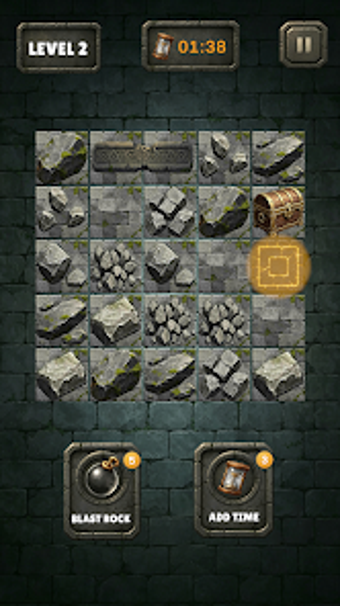
Chest Escape: Time-pressured sliding puzzles for quick sessions
Chest Escape, developed by LUCY WATKINS, is a casual Android puzzle title that tasks players with freeing a central chest on a grid-based stone board. The game has players slide the chest and a variety of obstacles under a ticking timer, testing spatial planning and rapid decision-making. Key elements include obstacle types with distinct movement constraints and progressively complex levels that increase challenge. It targets casual puzzle fans who enjoy quick, logic-driven matches and short play sessions.
What kind of game is Chest Escape?
Chest Escape is a single-player sliding-block puzzle that blends classic spatial logic with a countdown pressure. The core loop asks the player to slide a chest and surrounding pieces to open a path to a glowing exit. Movement rules differ by object type so players must plan sequences of moves rather than relying on random nudges, creating deliberate problem-solving in each short level.
Does it have a multiplayer mode and what mechanics shape play?
The game is built around solo puzzles rather than competitive or cooperative modes, focusing on constrained movement mechanics. Obstacles include four-way movers, horizontal-only, and vertical-only rocks, so each piece contributes a predictable constraint. The timer on each level enforces time-sensitive planning, rewarding efficient pathfinding and penalizing aimless shuffling with a countdown that can expire before the exit is reached.
What does the game look and sound like, and how clear is the interface?
The presentation is minimalist, centered on a stone board interface that keeps visual noise low and the puzzle readable. The clean layout emphasizes the board and piece orientations, which helps when visualizing multi-move solutions. Audio is understated to match the aesthetic, supporting focus rather than spectacle. The interface prioritizes the grid and object icons, which makes move directions and restrictions apparent at a glance.
Is it hard to get started and how does progression feel?
Onboarding is light and levels introduce obstacle constraints gradually through progressive design. Early puzzles present simple arrangements, then increase complexity by combining different movement rules. The imposed timer raises the difficulty curve because spatial solutions must be executed quickly as complexity grows. Players who enjoy planning several moves ahead will find the progression satisfying; those preferring relaxed, untimed puzzles may find the countdown adds consistent pressure.
What keeps players returning and what similar games does it resemble?
Replayability derives from tight puzzle design and short session length suited to mobile play, encouraging multiple attempts to improve completion speed. The mechanic set places the game in the same family as sliding-block and spatial-riddle titles, appealing to fans of classic board-style puzzles. Lightweight design and concise levels make it suitable for brief play bursts while still rewarding efficient solutions with faster completions.
Recommended for focused puzzle players who like time pressure
Chest Escape is a compact choice for players who prefer deliberate spatial puzzles with an added rush, thanks to its distinct piece movement rules and countdown-driven levels. It suits people seeking short, repeatable challenges rather than long sessions. Consider the developer's data safety notes about possible sharing of location and personal info when choosing whether to install.